

A Standard King bed measures 76 inches wide by 80 inches long (193 × 203 cm) the widest mainstream mattress size sold in North America. A California King is narrower but longer at 72 × 84 inches (183 × 213 cm), ideal for tall sleepers. Split King combines two Twin XL mattresses (38 × 80 inches each) for couples with different firmness needs or adjustable bases. You'll need a bedroom at least 12 × 12 feet to comfortably fit a king bed with nightstands and walking space.
Here's the secret nobody mentions when you upgrade to a king: the mattress is the easy part. The real questions surface afterwards.
Will it fit through your door? Will it leave room for nightstands? Are your sheets even the right size or did you accidentally buy California King ones and only realize after they don't tuck in? And what is a Wyoming King, exactly, and why does it exist? A king bed is one of the most important purchases in your home. You'll spend roughly a third of your life on it. It should be the easiest decision to get right but with eight different king variants on the market (yes, eight), it's also one of the easiest to get wrong.
This guide breaks down every king bed dimension, every variant, every room-size requirement, and every mistake to avoid so you order once, sleep right, and never wonder if you should've bought the longer one.
King Bed Dimensions at a Glance
Here's every king bed size in one master comparison.

Standard King Bed Dimensions Explained
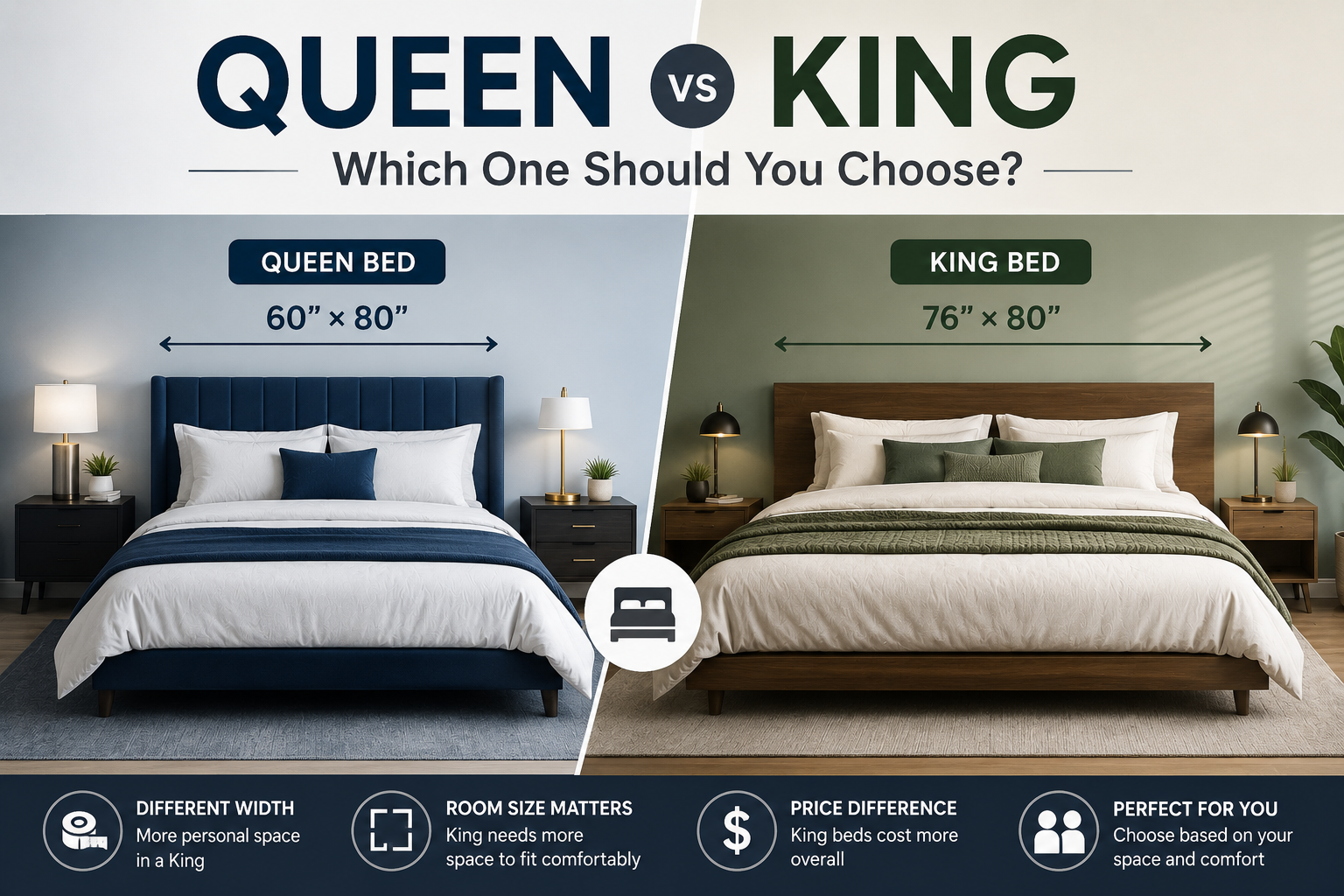
A Standard King (also called Eastern King in some retailers) measures 76 inches wide × 80 inches long 193 × 203 cm. It's the most popular king size in North America.
Quick facts
16 inches wider than a Queen (60 × 80 in)
Same length as a Queen
Each person gets ~38 inches of personal width roughly a Twin XL
Fits most master bedrooms in homes built after 1980
Best for
Couples who want maximum personal space
Families that occasionally co-sleep with a young child or pet
Sleepers under 6 ft 4 in
Rooms at least 12 × 12 feet
Not ideal for
Sleepers over 6 ft 4 in (consider California King)
Narrow bedrooms (consider Queen)
Tight staircases or hallways (it's hard to move)
California King Bed Dimensions Explained
A California King (Cal King) measures 72 inches wide × 84 inches long 183 × 213 cm. It's narrower but 4 inches longer than a Standard King.
Quick facts
4 inches longer than a Standard King
4 inches narrower than a Standard King
Each person gets ~36 inches of personal width
Bedding is NOT interchangeable with Standard King
Best for
Tall sleepers (6 ft 2 in and above)
Long, narrow master bedrooms
Single sleepers who like room to stretch
Couples without kids or pets in the bed
Split King Dimensions Explained
A Split King is two Twin XL mattresses (each 38 × 80 inches) placed side-by-side, creating a 76 × 80 inch surface the same total footprint as a Standard King.
Why it exists
Different firmness preferences. One side soft, one side firm.
Adjustable bases. Each person raises their head and feet independently.
Motion isolation. You don't feel a partner's movement.
Easier moving. Two smaller mattresses fit through tight stairwells.
Trade-offs
A visible gap or seam down the middle (mitigated with a topper or bridge)
You need King-size sheets OR two Twin XL fitted sheets depending on setup
Slightly more expensive (two mattresses + adjustable base)
Oversized King Beds: Wyoming, Alaskan & Texas
These are the giants non-standard sizes made by speciality manufacturers. Bedding has to be ordered custom.
Wyoming King
Dimensions: 84 × 84 in (213 × 213 cm)
Vibe: A perfect square. 8 inches wider than Standard, 4 inches longer.
Best for: Couples who co-sleep with one young child or pet.
Texas King
Dimensions: 80 × 98 in (203 × 249 cm)
Vibe: Long and wide. 18 inches longer than a Standard King.
Best for: Very tall sleepers who want extra width and families.
Alaskan King
Dimensions: 108 × 108 in (274 × 274 cm) 9 feet by 9 feet
Vibe: The largest mattress sold commercially.
Best for: Large families that co-sleep, or anyone who wants the biggest bed available.
King vs Queen vs California King
The three most-compared bed sizes in one decision table.

Quick Decision Rules
Under 6 ft tall + space-conscious → Queen
Couple wanting maximum width → Standard King
Tall (over 6 ft 2 in) → California King
Want both width AND length → Wyoming King or Texas King
Room Size Requirements for a King Bed
A king bed needs breathing room. Industry standard: at least 2 feet of clearance on three sides for comfortable walking, opening closets, and making the bed.

The 3-Foot Rule
Designers leave 3 feet of clearance on the side you walk past most (usually the closet side) and 2 feet on the other. Less than 18 inches and the room will feel crowded no matter how nice the bed.
Don't Forget Doorways & Stairs
Standard doors are 30–32 inches wide. Most king mattresses (especially bed-in-a-box) fit.
Innerspring mattresses are stiff and measure your stairwell turn before ordering.
Bed frames come in pieces; headboards do not. Confirm headboard dimensions.
King Bed Pros & Cons

Who Should Buy a King Bed?
Match your sleeping situation to the right king variant.

King Bedding Sizes
A king bed needs king-sized bedding. Here are the standard sizes.

King Mattress Thickness & Frame Considerations
Mattress Thickness
Modern king mattresses range from 8 to 16+ inches thick.

Watch out: A 14+ inch mattress can sit very high. Combined with a 12-inch bed frame, you may end up climbing into bed. Total surface height should be 24–27 inches for easy entry.
Frame Considerations
A king platform bed doesn't need a box spring
A traditional bed frame needs a king-size box spring or foundation
Look for center support legs required for most king frames
Bunkie boards can boost low platforms to comfortable height
Storage king beds with under-mattress drawers work well in small bedrooms
How Much Does a King Bed Cost?

Add to that
King bed frame: $250 – $2,500
King box spring / foundation: $150 – $500
King bedding set: $200 – $1,200
Pillows (×4–6): $150 – $600
Mattress protector: $40 – $150
Total realistic budget for a quality king setup: $2,000 – $5,000.
Common King Bed Mistakes to Avoid
Buying king-sized when your room can't fit it you'll trip past it every day
Forgetting nightstands most rooms need 2 ft on each side
Mismatching California King and Standard King sheets
Skipping the center support beam voids warranty
Buying a 14+ in mattress with no thought to frame height
Choosing California King in a square room wastes 4 inches of width
Ordering Alaskan King without measuring stairwells first
Forgetting that king sheets come in different pocket depths
Frequently Asked Questions
What are the exact dimensions of a king bed?
A Standard King mattress measures 76 inches wide by 80 inches long (193 × 203 cm). A California King measures 72 × 84 inches (183 × 213 cm). Both have nearly identical surface area but shape it differently.
Is a king or California king bigger?
They have nearly identical surface area. A Standard King is 4 inches wider; a California King is 4 inches longer. Choose California King if you (or your partner) are over 6 ft 2 in.
What size room do I need for a king bed?
For a Standard King, your bedroom should be at least 10 × 12 feet (minimum) or 12 × 12 feet (comfortable). California Kings need slightly more length at least 10 × 13 ft.
Will a king mattress fit through a standard door?
Most flexible memory foam mattresses (especially bed-in-a-box) will fit through a 30–32 inch doorway. Innerspring or hybrid king mattresses are stiffer and may require angling. Measure doors and stairwell turns.


Leave a comment
All comments are moderated before being published.
This site is protected by hCaptcha and the hCaptcha Privacy Policy and Terms of Service apply.